
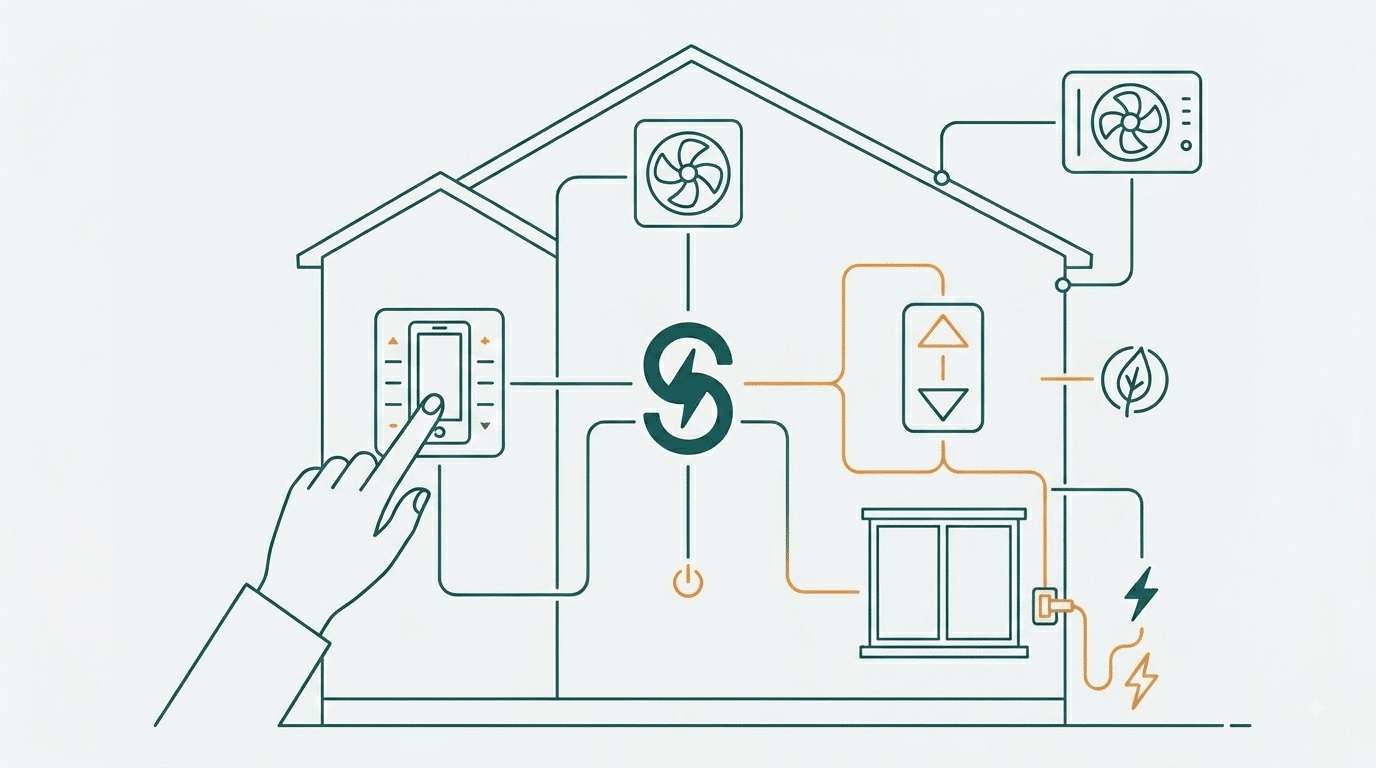
A smart thermostat lets you run your home’s temperature from your phone, from anywhere. In Arizona, where cooling is the biggest thing on the power bill, it’s usually the first piece of automation worth owning.
Here’s the quick version:
- The remote control is the part people buy it for. The scheduling is the part that actually saves anything.
- Certified units average about 8 percent off heating and cooling, which is smaller than most advertising implies.
- Arizona changes the math, because cooling savings count for more here than heating savings do.
- Check for a C wire before you buy. It’s the one thing that stops an install cold.
Smart Thermostat: The Best Way To Make Your House More Comfortable
Wi-Fi has made home automation more accessible than ever, and in the Valley homes we have been working in since 1994, a thermostat is the easiest place to start. You shouldn’t have to guess whether you left the house at 78 or 68 degrees, and you shouldn’t have to be home to fix it.
Below are four reasons to put one in, plus the limits on each, and where being part of a wider system changes the answer. A thermostat wired into the rest of the house behaves differently from one living alone in its own app, so I’ve marked where that difference shows up. If you want the wider picture of what else is worth automating, five smart ways to automate your home ranks the thermostat against lighting, plugs, leak sensors and appliances.
1. You Can Keep An Eye On Your Home, Even If You Are Far Away
It’s stressful to leave for a week and wonder whether you set the thermostat right. With a smart one you don’t wonder. You open the app, confirm the HVAC is running the way you left it, and change it if it isn’t.
On an integrated system it’s the same screen you’d use to run any other automation from your phone, so checking the house means checking one app instead of four. That sounds like a small thing until you’re doing it from a hotel.
That matters most for a house sitting empty in an Arizona July, and around here plenty of them are. A great many Valley homes go quiet through the hottest months while their owners are somewhere cooler, and a thermostat you can see from another state is the difference between catching a failed AC on day two and finding out in October. A unit that quietly stops working in a closed-up house is a problem you want to hear about on day two, not on day nine when you walk back through the door. The same logic covers a second home or a rental between guests.
2. Forget About Human Mistakes
Most wasted cooling isn’t a broken system. It’s a house held at 72 degrees all afternoon while everybody’s at work. A schedule fixes that without anybody having to remember anything.
Better units go further and learn the pattern themselves, or use your phone’s location to notice the house is empty. ENERGY STAR describes both automatic setbacks and geofencing as standard features on certified models. You set your preferences once and stop thinking about it.
Will A Smart Thermostat Work With My HVAC?
Usually, but check two things first. Most units need a C wire at the thermostat for constant power, and plenty of older Arizona homes were never wired with one. That’s fixable with an adapter or a short pull from the air handler. Second, multi-stage systems and heat pumps need a thermostat that specifically supports them, or you lose stages. Tell us what you have and we’ll confirm before anything gets ordered.
3. Receive Email Alerts
Your thermostat can tell you when the temperature moves outside the range you set, which in practice means it tells you when something has gone wrong. A power outage, a dropped Wi-Fi connection, or an HVAC system that has stopped keeping up.
Alerts arrive by email or text, so you’re not checking an app all day. In a Phoenix summer that early warning is the difference between a service call and a much larger repair.
Standalone, an alert tells you. On a system where the thermostat is tied into the rest of the house, the same event can also do something: drop the shades on the west side, or sit in one place alongside everything else the system is watching, so you’re not piecing together which app noticed what.
What Happens If The Wi-Fi Goes Down?
The schedule keeps running. A thermostat holds its program locally, so the heating and cooling carry on exactly as set even with no internet. What you lose is remote access and alerts until the connection returns, which is the opposite of what people fear. Ask specifically how a given model behaves offline before you buy, because a few cloud-dependent units handle it worse than others.
4. Lower Energy Bills
This is the reason most people lead with, so here is the size of it. Where home automation actually saves money covers the wider picture.
ENERGY STAR certifies smart thermostats using real field data from a large sample of homes rather than a lab test, and certified models average about 8 percent off heating and cooling bills, roughly $50 a year. To earn the label a model has to demonstrate at least an 8 percent cut in heating runtime and 10 percent in cooling.
Fifty dollars is less than the advertising suggests, and it’s an average across the whole country. Two things push Arizona above it. Of those two certification thresholds, cooling is the higher one, and cooling is what we actually run. ENERGY STAR also puts heating and cooling at almost half of a typical annual energy bill, and in a Phoenix summer that share is higher still. A percentage of a bigger number is a bigger number.
How Much Will It Actually Save Me?
More than the national average if you cool a Phoenix house, less if your household already runs a disciplined schedule. The savings come from the hours the system doesn’t run, so a home that’s empty on weekdays gains most and a home with someone in it all day gains least. Nobody can quote you a figure without knowing your schedule and your system, and anyone who does is guessing.
I recently had them install 8 TVs, 11 security cameras, a full home security system, a 10-speaker outdoor audio setup, smart thermostats, smart garage door openers, and a long list of other smart-home upgrades.
… Not once did they try to upsell me anything. In fact, they actually talked me out of buying several entertainment and automation products I thought I needed, simply because they believed they weren’t necessary for my setup.
MJK ★★★★★
Does It Matter When I Cool, Not Just How Much?
In Arizona it does. Peak evening demand is largely met by natural gas combustion turbines, which the EIA notes run at lower efficiency than combined-cycle plants, so power drawn at 6 p.m. burns more fuel than the same power at noon. On a plan like SRP’s Manage Demand 5 to 10 p.m. it costs more too. Pre-cooling before the window and easing off during it addresses both.
Are Smart Thermostats Better Than Traditional Thermostats?
For most homes, yes, though the comparison is narrower than the marketing suggests. A traditional thermostat holds a temperature. A smart one holds a temperature, follows a schedule, reports what it did, and can be changed from anywhere.
Where that stops being worth it: a small home with a simple system and someone in it most of the day gains very little, because there are few empty hours to claw back. My opinion, and it’s an opinion, is that the schedule and the reporting justify the upgrade even when the dollar savings are modest, because knowing what your system actually did is worth something on its own.
If you’re weighing the whole idea rather than just this one device, whether smart home devices are worth the fiddle factor is a fair look at the annoyances, and six things worth sorting out before installation covers the planning.
Do I Need One For Every Zone?
One per zone, if your house is zoned at all. Each zone has its own thermostat and its own damper, so a single smart unit only controls the area it’s wired to. Most Phoenix homes are single zone and need one. Two-story homes are the common exception here, and putting a smart thermostat on the upstairs zone alone often gets you most of the benefit, since that’s the zone doing the hardest work in summer.
The One Room That Should Have Its Own Zone
If your house is zoned, or could be, the media room is the strongest candidate for a zone of its own. It is the only room that generates its own heat and then asks you to sit still in it.
Think about what is in there. A projector or a large panel, a receiver, a subwoofer amp, a rack of source gear, and then a room full of people, usually behind a closed door with no window. All of it turns electricity into heat in a sealed box. The room climbs while the rest of the house sits where the thermostat says it should, and if the two share a zone you get one of two bad outcomes: the theater is warm, or you overcool the whole house to fix one room.
Commercial cinemas run cold on purpose, and it is worth copying. Part of that is equipment load, and part is that a warm dark room makes people drowsy about forty minutes in, which is the opposite of what anyone wants from a film they were looking forward to.
The automation is the easy part once the zone exists. The same scene that dims the lights can drop the theater a few degrees a little before viewing starts, then hand it back afterward. Pre-cooling matters here for the same reason it does everywhere else in Arizona: bringing the room down before the on-peak window costs less than fighting it during.
The honest limit, and it is a real one: this only works if the house is zoned or you are at a stage where zoning can be added. Retrofitting a zone into a finished house means dampers and duct work, and it is rarely worth it for one room on its own. Worth raising while a room is being built out, not after. The essential elements of a custom home theater covers what else gets decided at that stage, and we build them across the Valley including Chandler and Queen Creek.
How To Get The Best Custom Home Automation For Your House
If you want a thermostat integrated with the rest of the house rather than sitting on its own, that’s what we do. The team at Stabley Home Entertainment is a custom audio, video and automation company serving the Phoenix metro, family owned and operated since 1994. Finished work is in the project galleries.
Lighting is the usual next step once the thermostat is in, and using lighting control with a home automation system covers how that works. Moving into a new build and want it all handled before you unpack? That’s what the move in tech packages are for.
Contact us for a free quote, or call (480) 325-5015. Tell us your HVAC type and whether you know if you have a C wire, and we can give you a real answer rather than a range.

Stabley Home Theater
1350 S Greenfield Rd #1127
Mesa, AZ 85206
Office: (480) 325-5015
Email: [email protected]
Website: https://stabley.net
Related Posts


